

How Blockradar connects wallets, auto-settlement, unified balances, and Earn to make building financial products simpler.
Most capital is either moving or waiting to move. A merchant might set money aside for their next stock order, just as someone receiving remittance funds might spend part of those funds on groceries while the rest is being saved for school fees. They both know what the money is for, but whether they can earn anything on it in the meantime depends on what’s available to them and whether they can get the money back when they need it.
That’s where we saw an opportunity for our fintech customers, many of whom serve people and businesses across the Global South. Their customers can already receive money, hold a balance and pay from the same wallet, with stablecoins under the hood. We wanted to give fintechs a way to extend that relationship to the money customers set aside, so a merchant waiting to restock or a family saving part of a remittance could choose to earn on some of that balance in the wallet they already use. That’s why finding the right partners mattered. We wanted fintechs to be able to offer that option with confidence and explain to their customers where the earnings come from and how the underlying lending is regulated.
That’s where our work with Ground and Tempo began. Through Tempo Earn, we integrated Hastra-issued PRIME on Tempo, giving eligible customers a way to earn through Blockradar Earn, with returns tied to real-world lending. For us, understanding the regulatory framework behind that lending was part of choosing what our fintech customers could offer.
Making Earn part of the financial experience
Consider a fintech that wants to offer customers the opportunity to earn on idle stablecoin balances. Its engineering team could integrate wallets, monitor deposits, connect to lending protocols, manage transactions, calculate earnings, and build withdrawal flows. But that introduces several systems to maintain, each with its own APIs, requirements, and failure scenarios.
We wanted to make that experience considerably simpler.
Earn provides a common interface for working with different providers. Whether the underlying protocol is Aave, Compound, or a share-based vault, developers can use consistent capabilities to manage deposits, withdrawals, balances, and earnings. When we integrated Ground on Tempo, we extended that existing system rather than introducing a completely separate workflow. For businesses already using Blockradar, this means another earning opportunity can become part of their existing financial infrastructure.
And when combined with features such as auto-settlement and unified balances, the experience goes beyond simply depositing funds into a lending protocol or vault.
Bringing Tempo, Ground, and PRIME together
The collaboration brings together 3 complementary pieces of infrastructure.
Blockradar provides the wallets, payment rails, transaction orchestration, auto-settlement, unified balances, Earn APIs, and developer experience.
Tempo provides the stablecoin-focused blockchain infrastructure and Tempo Earn, which connects our fintechs to PRIME.
Ground provides the vault infrastructure, including deposits, redemptions, vault-share accounting, and fee management.
What is PRIME?
PRIME is a tokenized real-world asset issued by Hastra. It provides exposure to a pool made up mostly of US home equity lines of credit. Unlike some DeFi lending protocols where borrowers use cryptocurrency as collateral, this lending activity is connected to real-world credit. Borrowers pay interest on their loans, and that lending activity generates the underlying returns.
The home equity lines of credit behind PRIME are originated by Figure, a Nasdaq-listed lender, and the lending runs through Democratized Prime, a lending marketplace on the Provenance blockchain. PRIME itself is built on YLDS, an SEC-registered stablecoin. Customers accessing PRIME through Ground hold vault shares representing their positions. As the underlying strategy generates returns, the redeemable value of those shares can increase.
One important part of the integration is making withdrawals very practical.
Real-world loans can have long repayment periods, but customers may need to access their funds much sooner. Vaults on Tempo use built-in exchanges to support redemptions, within the liquidity available. This matters for fintechs and treasury products, where businesses need to balance earning opportunities with access to funds.
From receiving Money to earning on it
Imagine a customer in Brazil who receives money in Brazilian reais (BRL) through a fintech app and wants to put some of it aside to earn. They don't need to understand stablecoins or how blockchain transactions work. Through Blockradar's virtual accounts or fiat deposit infrastructure, the money is converted into stablecoins and credited to their wallet. Blockradar then detects the incoming stablecoins as a deposit, allowing a configured auto-settlement rule to automatically move eligible funds into Earn, all within the same infrastructure. Once the fintech sets up the rule, incoming reais are automatically converted to stablecoins, and the eligible portion goes into Earn. Neither the customer nor the fintech needs to take any action on each deposit if they do not want to.
One of the most useful parts of Blockradar's infrastructure is auto-settlement. It allows businesses to configure rules that determine what should happen when funds arrive in a wallet. For example, a fintech can configure eligible stablecoin deposits on Tempo to be automatically allocated to Earn.
curl --request POST \
  --url 'https://api.blockradar.co/v1/wallets/{walletId}/auto-settlements/rules' \
  --header 'Content-Type: application/json' \
  --header 'x-api-key: <api-key>' \
  --data '{
    "type": "earn",
    "name": "Earn on Tempo deposits",
    "isReward": true,
    "rewardProvider": "ground",
    "rewardType": "regulated",
    "source": {
      "assets": ["USDC.e"],
      "minAmount": "10",
      "maxAmount": "-1"
    },
    "destination": {
      "blockchain": "tempo",
      "asset": "USDC.e"
    }
  }'
Once the rule is configured, the developer doesn't need to make a separate Earn API call every time a customer receives funds. Blockradar handles the process, from fiat conversion and deposit detection to allocating the funds into Earn and updating the customer's position.
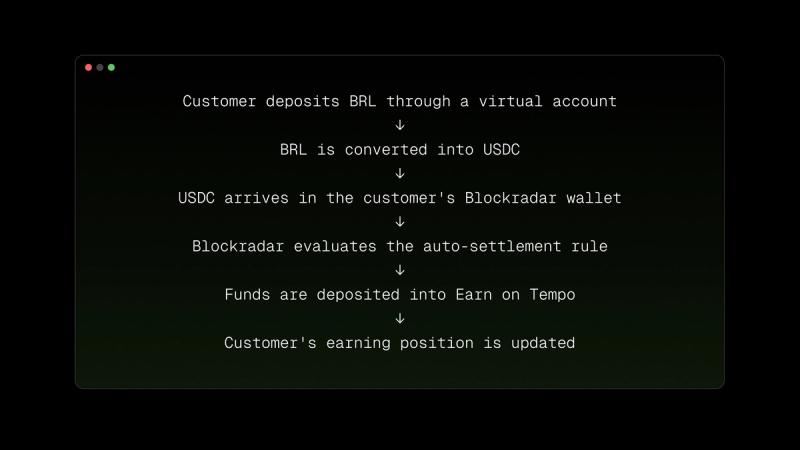
Behind this experience, Blockradar helps manage the necessary blockchain interactions, provider requirements, and position tracking. The direct Earn auto-settlement rule works with supported assets on the same network. Funding from other networks can be coordinated separately through supported routing and unified funding operations.
Another important detail is customer ownership. Blockradar supports individual child wallets for a business's customers. Each wallet can hold its own vault shares rather than requiring every customer's investment to be combined into one shared position. This makes customer-level balances and earnings easier to manage. For developers, the value is straightforward: they can focus on the financial experience they're building while Blockradar handles the infrastructure underneath.
Going further with unified balances
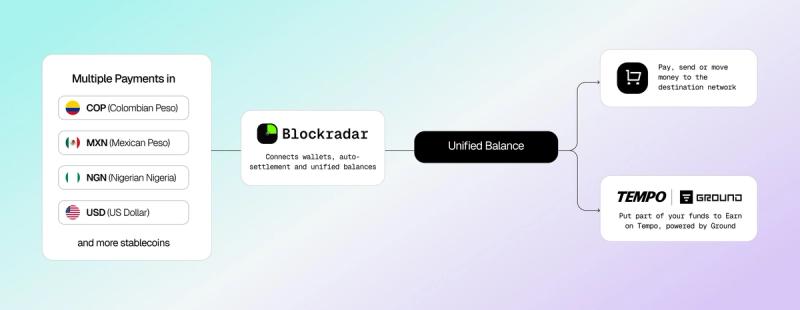
Auto-settlement makes it easier to move incoming funds into Earn. But what happens when a business wants to fund an Earn deposit using balances spread across several wallets or blockchains?
Imagine a fintech that collects payments in COP, MXN, NGN and USD. Those payments can settle into different stablecoins across multiple wallets or networks, leaving the fintech with balances in several places when it wants to fund a single Earn deposit.
It wants to allocate 1,000 USDC to Earn on Tempo, but the full amount isn't available on one blockchain.
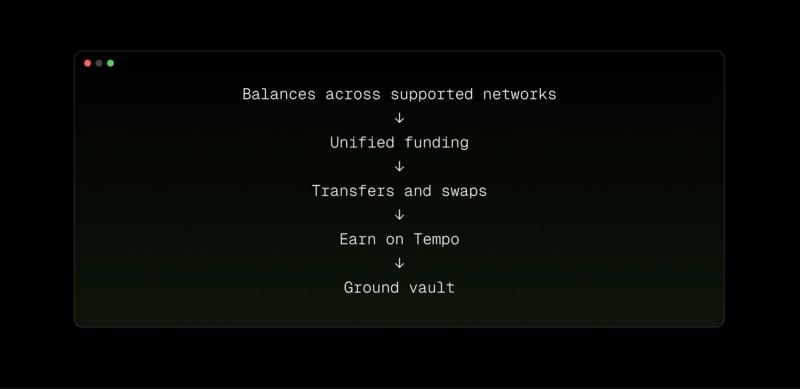
Traditionally, its developers would need to identify the available balances, coordinate transfers or swaps, move the funds to the destination network, and then initiate the Earn deposit. This is where Blockradar's unified balances and unified actions become useful. We've built infrastructure that allows businesses to fund supported financial operations using balances from multiple sources. The system can coordinate the necessary transfers and conversions before completing a withdrawal or swap.
We're extending that same infrastructure to Earn.
Rather than gathering funds for a withdrawal, the final destination can be a supported Earn vault.
What this means:
- For developers, this removes much of the manual orchestration required to work with fragmented balances.
- For fintechs, it makes it easier to put eligible funds to work without first consolidating everything themselves.
- And for customers, it creates a more connected experience between receiving, managing, and earning on their money.
What we learned integrating Ground on Tempo
Although we already had an existing Earn system, integrating Ground on Tempo introduced some interesting engineering challenges. One in particular stood out.
When the money you're depositing also pays the gas
On networks like Ethereum, users generally need a separate native asset, such as ETH, to pay transaction fees. Tempo works differently. Stablecoins are the default for all network transaction fees. From a customer's perspective, this is convenient. They don't need to hold another asset just to execute transactions. But it introduced an interesting challenge for our infrastructure.
Imagine a customer holding exactly 100 USDC who wants to deposit their entire balance into Earn.
If the same USDC is also needed to pay the transaction fee, attempting to deposit all 100 USDC leaves nothing to execute the transaction.
This becomes particularly important with auto-settlement, where a rule may automatically attempt to invest the entire available balance.
Our solution was to introduce a fee reserve.
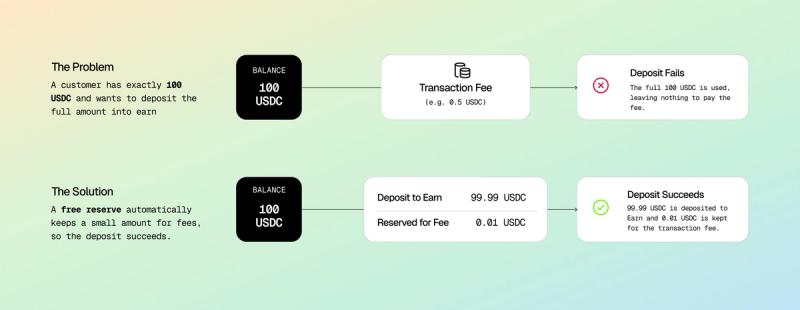
We also adapted our infrastructure to support different network fee models rather than treating Tempo as a collection of special cases. It's a relatively simple concept, but solving it properly required thinking about how deposits, withdrawals, and wallet balances work together.
We encountered another interesting challenge with precision.
Ground's vault shares use 18 decimal places, while USDC uses 6. During testing, we found that calculating share values using insufficient precision could introduce small differences in withdrawal amounts. We refined the conversion calculations to preserve greater precision. Neither challenge is something a business integrating our Earn APIs should have to solve independently. That's part of the value of building these capabilities into the infrastructure itself.
Building financial products without rebuilding the infrastructure
There is a lot involved in offering a way to earn beyond the actual investment. Developers need to think about wallets, transaction fees, provider requirements, balances, earnings, withdrawals, and what happens when an operation cannot complete immediately. With Blockradar, much of this is handled through the infrastructure fintechs already use.
- A fintech building a savings feature can offer eligible customers a way to earn without maintaining separate integrations for every underlying protocol.
- A business managing treasury funds can configure automated allocation rules rather than manually initiating every deposit.
- And a payments platform can use unified funding to coordinate supported balances before moving them into an earning position.
The aim isn't to hide the nature of the underlying financial product. Customers still need to understand variable returns, eligibility requirements, and liquidity risks. It's to make the infrastructure easier for developers to work with and the overall experience easier for businesses to deliver.
Beyond the deposit
When a merchant receives a payment, some of that money might go straight back out and some might sit until it’s time to restock. The work we did with Ground and Tempo gives fintechs a way to offer that merchant the option to earn on the part they set aside. An auto-settlement rule can move eligible funds from the wallet into Earn, where the merchant holds shares in a Ground vault that provides access to PRIME on Tempo. When it’s time to buy stock, the merchant can request a redemption back to the wallet they use to pay their supplier.
We had to build for both ends of that journey. We had to leave enough USDC in the wallet to pay for transactions and carry enough precision through our calculations to show what those vault shares are worth when a customer wants to redeem them. Those details connect the moment the payment comes in to the moment the money is needed again. For the merchant, it’s still the money they set aside for their next order. Now their fintech can give them a way to earn on it in the time between.
If you’re building a payments platform, remittance app or treasury product, you can explore Blockradar Earn in the dashboard or get started with the API documentation.
Explore Blockradar, Tempo Earn, and Ground.
About Blockradar
Blockradar provides secure, developer-friendly stablecoin infrastructure for fintechs. Our non-custodial wallet APIs, settlement rails, transaction monitoring, and AML compliance tools make it easy to launch and scale stablecoin-powered financial services. From USDC and USDT payouts to onchain expense management, we help companies move money instantly and safely across borders—without building blockchain infrastructure in-house.
Blockradar is trusted by payment platforms, remittance providers, and Web3 startups building the future of finance.
Explore our API documentation and get started at https://blockradar.co